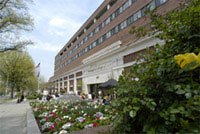
Dean Claudio M. Grossman asserts, "Our students benefit from externships with governmental and nongovernmental institutions around the world; our renowned programs in clinical education, intellectual property, human rights, government, business, and environmental law; and from a dedicated faculty. Many students participate in one of our 11 journals and publications.
"Most of all, WCL students benefit by being part of a diverse and proactive student body, constantly seeking fresh challenges and creating new opportunities through WCL's exciting wealth of student organizations. This diverse community is further enriched by lawyers from all over the world who participate in our International Legal Studies Program and our Program in Law and Government."
Located just 20 minutes from the White House, the law school has a unique history among American legal education institutions. It was established in 1896 by Ellen Spencer Mussey and Emma Gillett, two pioneering women who made their mark on a national institution which still officially barred women from becoming legal practitioners.
Admission to WCL is considered selective with 23% of applicants being offered admission. For the 2007 entering class, a total of 8,401 applications were received with less than 6% of applicants enrolling at the beginning of the school year.
The school offers law courses at both full-time (12 or more credit hours) and part-time status (less than 12 credit hours). A minimum of 86 semester hours is needed to obtain a Juris Doctor degree.
- Center for Human Rights and Humanitarian Law
- Clinical Program
- Externship Program
- Health Law Project
- Humphrey Fellowship Program (Fulbright Exchange)
- International Arbitration Program
- International Legal Studies Program
- International Visiting Scholars Program
- Marshall-Brennan Constitutional Literacy Project
- National Institute of Military Justice
- National Institute of Corrections/WCL Project on Addressing Prison Rape
- Office of Public Interest
- Program on Information Justice and Intellectual Property
- Program on International and Comparative Environmental Law
- Program on Law and Government
- Special Events and Continuing Legal Education
- Trial Advocacy Program
- War Crimes Research Office
- Women and International Law Program
- Women and the Law Program
The median LSAT score for full-time students was 162 with the corresponding 25th- and 75th-percentile scores at 161 and 163. Part-time students garnered a median LSAT score of 160 with 159 and 161 being the 25th- and 75th-percentile LSAT scores.
Full-time tuition for the 2008-2009 academic year stands at $38,652; part-time tuition totals $27,189. Additional expenses, including school fees, housing, food costs, books and supplies, and transportation, bring the estimated total cost of one year at WCL to $59,919 for full-time students and $47,882 for part-time students.
Financial aid is available for students, mainly through federal and state loans for those who qualify. Most student loans are procured through the federal Stafford Loan and Graduate PLUS programs and through private banks and lenders.
Famous WCL alumni include U.S. senator from West Virginia Robert Byrd, Maryland House of Delegates member Kirill Reznik, CNN correspondent Joe Johns, and film producer Roy Lee.
Learn the 10 Factors That Matter to Big Firms More Than Where You Went to Law School